The New York Retail Worker Safety Act Panic Button Requirement: How to Comply Before January 1, 2027
The New York Retail Worker Safety Act requires retail employers with 10 or more retail employees in New York State to maintain a workplace violence prevention policy, notice, and training program, all in effect since June 2, 2025. Employers with 500 or more retail employees statewide must also provide every retail employee with a silent response button by January 1, 2027, and train them on how to use it. A silent response button lets an employee discreetly request immediate assistance from a security officer, manager, or supervisor, and it is not a 911 dialer.
That is the law in three sentences. Complying with it across 20, 50, or 200 stores is a different problem, and it is the one this post is about. This is general information about a compliance obligation, not legal advice. Confirm your own coverage and program with counsel.
What does the Retail Worker Safety Act actually require?
New York enacted the Retail Worker Safety Act in September 2024 as Section 27-e of the Labor Law, then amended it on February 14, 2025. The amendment matters, because it changed both the deadlines and the nature of the button requirement.
As the law stands today, covered retail employers have two sets of obligations.

Policy, notice, and training, in effect since June 2, 2025. Retail employers with 10 or more retail employees in New York State must adopt a workplace violence prevention policy, distribute it in writing at hire and annually, and deliver interactive training on it. The New York State Department of Labor published a model policy, model training, and guidance on May 29, 2025. Employers can adopt the model or run their own program that meets or exceeds it. Employers with 50 or more retail employees train annually. Employers with 49 or fewer train every two years. Training has to happen on paid work time.
Silent response buttons, deadline January 1, 2027. Retail employers with 500 or more retail employees in New York State must provide every retail employee with a silent response button, and must train employees on how to use it. The threshold was originally 500 employees nationwide. The February 2025 amendment narrowed it to 500 statewide.
Who is covered by the New York Retail Worker Safety Act?
Coverage turns on statewide headcount, not per-store size. A retailer with five employees in each of two New York stores is covered, because the law counts all retail employees in the state together. Only retail employees count toward the threshold, so a store with seven retail employees and five marketing and administrative staff is not covered.
A retail store is one that sells consumer commodities at retail and is not primarily engaged in selling food for consumption on the premises. That excludes restaurants and captures most traditional retail formats.
One point catches employers by surprise. NYSDOL guidance states that employees who work on site at a retail store are covered even when their employer is not a retailer. A cleaning company whose staff work in retail stores is covered and must deliver the policy and training itself. The same logic reaches contract merchandisers, contract security, and other vendors with a standing on-site presence. If you run one of those firms, the obligation is yours, not the store's.
The silent response button requirement uses the higher 500-employee statewide threshold. For a multi-location retailer, that math adds up quickly: a chain averaging 25 employees per store crosses 500 at roughly 20 New York locations.

What counts as a silent response button?
A silent response button is a device that lets a retail employee silently summon immediate help from a security officer, manager, or supervisor. It is not a 911 dialer. The original 2024 law defined a panic button that would contact the local 911 public safety answering point directly and dispatch law enforcement. The February 2025 amendment removed that language. The current requirement routes the alert to internal responders, who assess the situation and escalate to law enforcement when warranted.
Every retail employee has to have one. The law allows three form factors: a device installed in an easily accessible location in the workplace, a wearable button, or a mobile phone-based button. A fixed installation can satisfy the obligation for the employees who work near it, which is why placement and floor plan matter as much as procurement. Nothing in the law stops you from mixing form factors across roles and store layouts.
Does a mobile app satisfy the requirement?
Yes, with two restrictions written into the statute.
Mobile phone-based silent response buttons may only be installed on employer-provided equipment. Personal phones are out.
Wearable and mobile phone-based buttons may not be used to track employee locations except when the button is triggered. Always-on location monitoring is not permitted, even if the employee agrees to it. If you are evaluating a platform that shares live location continuously, that behavior has to be turned off for your New York retail workforce.
This is where compliance stops being a legal question and becomes an operational one. A mobile-based button means issuing and managing devices, installing and updating an app across a fleet, provisioning accounts for every employee, configuring location behavior correctly, and keeping all of it current in an industry where staff turn over constantly. The button is the easy part. The system around it is the work.
What training does the button requirement carry?
The statute requires that workplace violence prevention training include instruction on the use of security alarms or buttons and other related emergency devices. NYSDOL states directly that covered employers must provide employees with training on silent response button use. Employers who adopt the state's model training are expected to add site-specific content, including instruction on the security devices actually used in that store and how they work.
In practice, that means your button rollout and your training update are the same project. A store that receives devices in December 2026 without the accompanying training is not compliant on January 1.
How is the Act enforced?
Enforcement sits with NYSDOL's Safety, Health, and Essential Rights program. Employees can file complaints, and the Department has committed to keeping them anonymous where feasible.
It is not only complaint-driven. In June 2026, NYSDOL reported that inspectors had performed 430 proactive outreach visits to retail locations affecting 13,000 retail employees since the Act took effect, advising employers and employees on the law's requirements. Assume an inspector can walk in.
Section 27-e does not specify its own penalty amounts, and it does not create a private right of action on its face. What it does create is a documented standard of care. NYSDOL notes that maintaining incident records and running an internal reporting system are not required, but recommends both as best practice for identifying trends. The retailer that can produce training rosters, policy distribution records, and incident response logs is in a categorically better position than the one that cannot, whether the person asking is an inspector or a plaintiff's attorney.
Compliance across many stores is an operations problem
Single-purpose button hardware answers the statute and nothing else. A platform answers the statute and the operational reality around it.
Requirement-by-requirement: what the Act asks and where a platform helps
Requirement | Applies to | Powered by PushPulse | How |
Provide every retail employee a silent response button | 500+, by Jan 1, 2027 | ✅ | Mobile app, wall-mounted or mobile tablet, or Bluetooth wearable button, mixed by role and floor plan |
Silent activation, no audible or visible signal | 500+ | ✅ | One-tap silent activation with no sound and no screen activity an aggressor would notice |
Route the request to a security officer, manager, or supervisor | 500+ | ✅ | Responder routing by site and role, with time-stamped acknowledgment logs |
Install mobile buttons only on employer-provided equipment | 500+ | ✅ | Deploys through your MDM to employer-provided devices |
Do not track employee location except when triggered | 500+ | ✅ | Location sharing is a per-organization setting and can be scoped to activation only |
Distribute the policy at hire and annually | 10+ | ✅ | Document library delivers it to every employee, with document analytics showing who opened it |
Communicate site-specific exits and meeting places | 10+ | ✅ | Site-specific maps, procedures, and documents available where staff work |
Maintain incident records and a reporting system | Recommended, not required | ✅ | Automatic incident timelines, custom incident report forms, and multisite reporting |
Train employees on silent response button use | 500+ | Partial | Drill planning, documentation, and SOP distribution are built in; the training content is yours |
Adopt a written workplace violence prevention policy | 10+ | No | The policy comes from the NYSDOL model or your counsel |
Provide interactive workplace violence prevention training | 10+ (annual at 50+, biennial below) | No | The interactive training is NYSDOL's model or your training provider's |
Provide notice in English and the employee's primary language | 10+ | No | NYSDOL publishes the translated templates |
Three of those rows are not a technology problem at all. The policy, the interactive training, and the translations are yours to adopt, and NYSDOL publishes all three at no cost. Everything above that line is where the operational work actually lives.
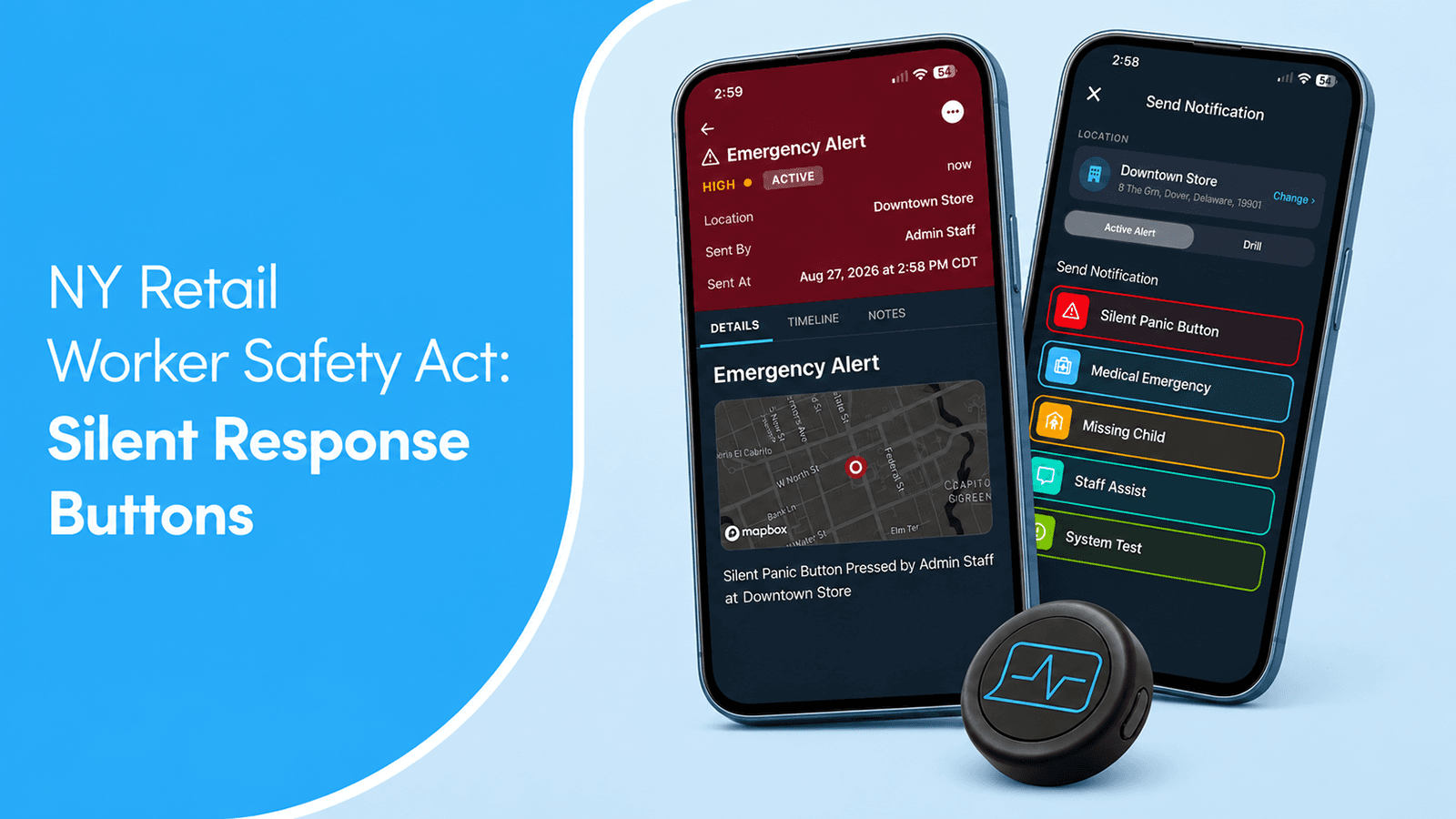
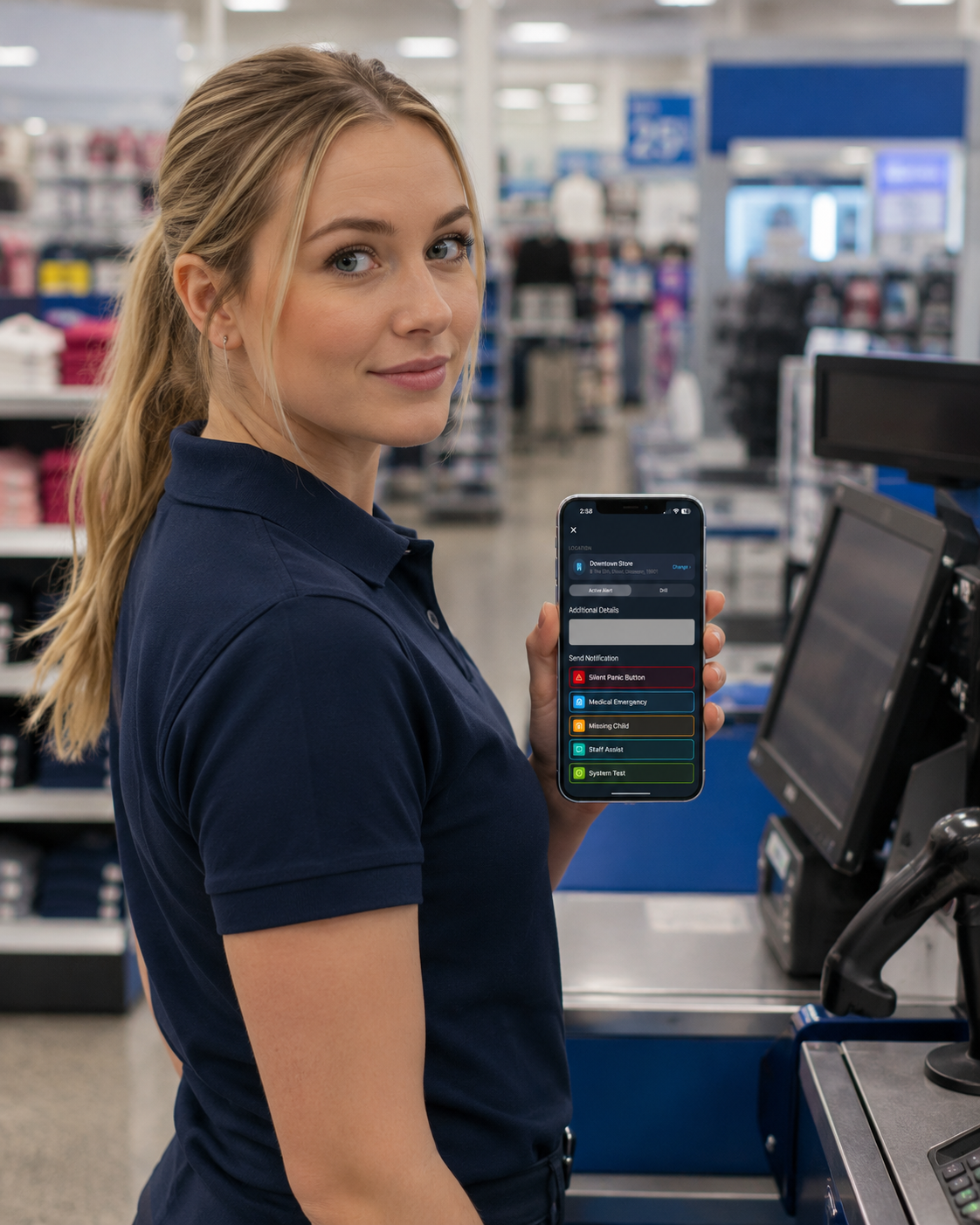
Silent activation in the form factor each role needs. A store employee taps once on a store device or presses a Bluetooth wearable button, and a silent alert goes out immediately with the store identified. No sound, no visible screen activity, no dependence on finding the right person in the building. Because the law permits fixed, wearable, and mobile-based buttons, one platform supporting all three lets you match form factor to role and floor plan instead of forcing one answer on every store. See how panic activation works across every surface.
Location shared only when the button is pressed. Location sharing is configured per organization. It can be scoped so that an employee's location is attached to the alert at activation and not shared at any other time, which is exactly the line Section 27-e draws. Deployments outside New York can be configured differently. The point is that the constraint is a setting, not a limitation you have to work around.
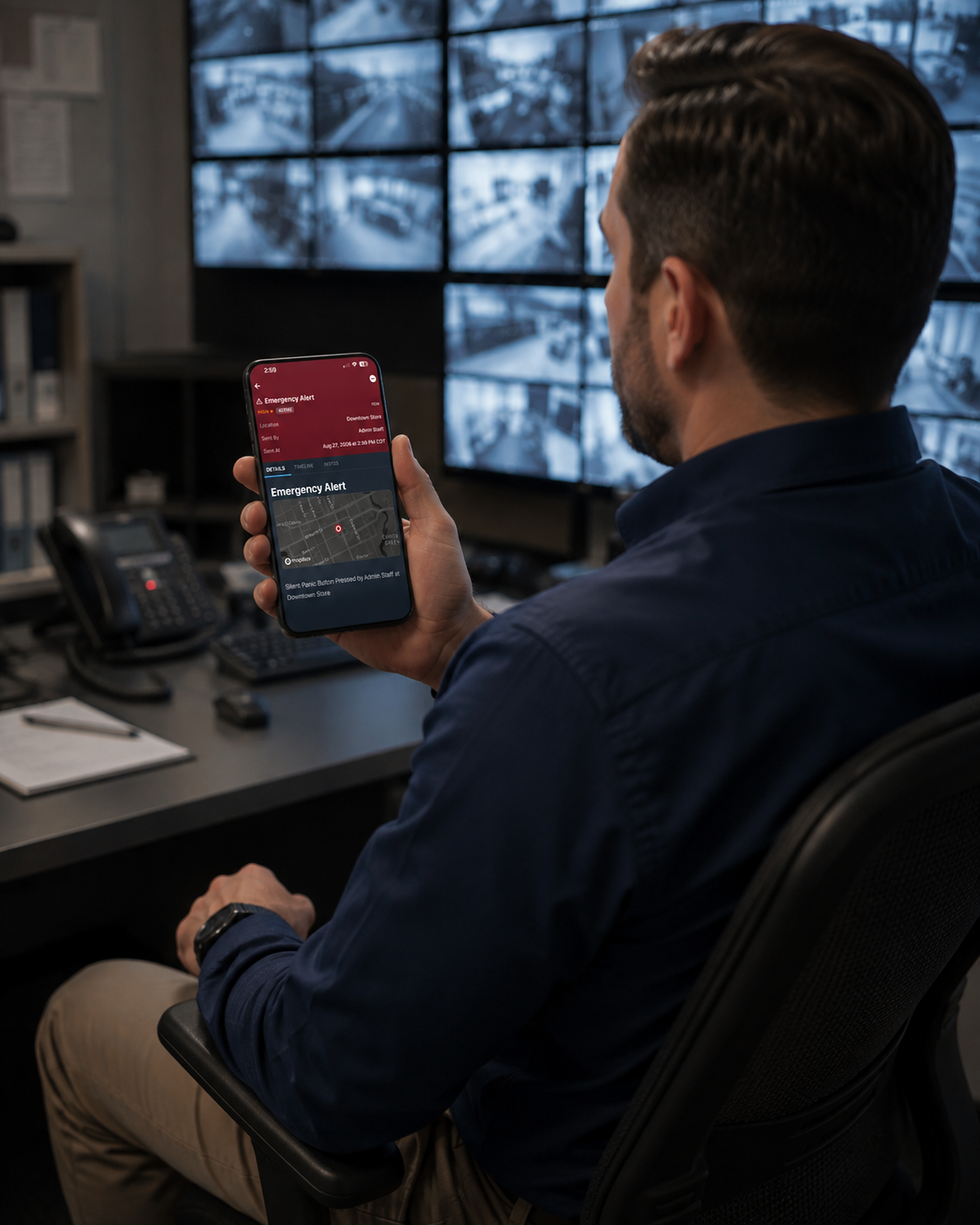
The alert has to reach a person who responds. Alerts route to designated responders by site and role across push, SMS, email, and voice, with Do Not Disturb override. Every notification and acknowledgment is time-stamped, so you can see who was reached and who confirmed. A button that fires into an unmonitored inbox satisfies nobody, least of all the employee who pressed it.
One system, not one device. The alert engine behind the button also handles severe weather, evacuations, medical emergencies, and active threat situations through pre-approved templates. Corporate writes the wording once, and every store sends consistent messaging instead of improvising. The silent response button becomes one scenario in a library your teams already use, which is the difference between a system people know how to operate and a device nobody has touched since installation.
Fleet deployment and access control. PushPulse deploys through mobile device management, so the app lands on employer-provided devices without store-by-store installs. Access is role-based: associates trigger alerts, managers send and manage them, corporate controls templates, routing, and policy content. Accounts can be deprovisioned manually from MDM or automatically when a device has not checked in for a set number of days. Organizations on enterprise plans can add single sign-on and SCIM provisioning, so employees authenticate with existing corporate credentials and offboarding follows the identity provider.
Groups that stay current. Retail turnover makes manually maintained recipient lists useless within weeks. Groups are built dynamically from location assignment, role, and other attributes, so an alert to a single store or to every New York district manager always resolves against current membership. With SSO enabled, group routing can follow attributes from your identity provider.
Policy distribution and documentation. The document library distributes your workplace violence prevention policy and training materials to every employee, and document analytics show who opened what. When the policy has to go out at hire and annually, distribution with per-user records beats an email blast and hope. Custom forms capture workplace violence incident reports and follow-up documentation in a consistent structure across every store, and incident management builds the timeline automatically from the moment an alert fires.
Reporting across the footprint. Multisite reporting covers alert response times, incident trends by store and region, and drill participation. That is the audit trail if NYSDOL asks. Day to day it is more useful than that: it shows which locations generate incidents, which respond slowly, and where training is not landing.
The deadline is real, and the checkbox is the wrong goal
January 1, 2027 is close enough that device selection, deployment, configuration, and training all need to start now for a large fleet. Retailers evaluating options should ask a bigger question than whether a product satisfies Section 27-e. The mandate is a reason to put a real safety operations layer across every store: silent alerts, emergency notifications, incident documentation, policy distribution, and reporting in one place.
What does compliance look like across your specific store footprint? Book a demo and we will map the silent response button requirement, and everything around it, to your locations. You can also see how the platform works for multi-site workplaces.